 IDA Pacific
Hospital use items are the medicines, consumables, instruments, diagnostics and equipment a facility relies on every shift, and planning them well is what keeps wards running when the next shipment is weeks away. For hospitals and larger health centres across Vanuatu, the Solomon Islands, Papua New Guinea, Fiji and the wider Pacific, the challenge is not knowing what a hospital needs in theory. It is deciding what to hold, in what quantity, and how to keep it usable in heat, humidity and long supply lines.
This guide groups hospital use items into eight practical categories, explains what each department typically draws on, and gives buyers decision criteria, a comparison table and a step-by-step stocking process. It is written for pharmacists, store managers, nurse unit managers and procurement officers, not as clinical guidance.
What Counts as Hospital Use Items?
In procurement terms, hospital use items are anything a facility consumes or uses in patient care that is not a building fixture. That ranges from a box of examination gloves to an infusion pump. The useful distinction for buyers is how each item behaves in your store: how fast it moves, whether it expires, whether it needs special storage, and what happens clinically if it runs out.
Thinking in categories rather than long alphabetical lists makes ordering, storage and audits far easier. It also helps you match each category to the right budget line and reorder rhythm.
Consumables versus durables
- Consumables are single-use or short-life: syringes, cannulas, dressings, gloves, sutures, test strips, reagents.
- Durables are reused over months or years: stethoscopes, BP monitors, instruments, trolleys, oxygen concentrators.
- Medicines sit in their own controlled category because of expiry, storage temperature and regulatory handling.
Consumables drive most order volume. Durables drive most capital spending and maintenance planning. Medicines drive most compliance work.
The 8 Essential Categories of Hospital Use Items
The categories below cover the core of what Pacific hospitals and referral health centres stock. Your formulary and service level will shape the detail, but nearly every facility needs something from each group.
1. Essential medicines
Medicines form the clinical backbone of any hospital store. Most Pacific ministries base their national lists on the WHO Model Lists of Essential Medicines, adapted to local disease patterns. Typical groups include antibiotics, analgesics, IV fluids, antimalarials where relevant, maternal health medicines and chronic disease treatments. Browse the essential medicines range to compare forms and pack sizes.
2. Surgical supplies
Theatres and procedure rooms use sutures, scalpel blades, surgical drapes and gowns, sterile gloves, swabs, catheters and drainage sets. Sterility and packaging integrity matter more here than anywhere else. See the surgical supplies catalogue for sterile and procedure items.
3. Medical supplies and consumables
This is the highest-volume group: syringes, needles, IV cannulas and giving sets, dressings, bandages, tapes, examination gloves, masks, cotton wool and incontinence products. These are the hospital use items most likely to run out without warning because every ward draws on them daily.
4. Diagnostics and laboratory supplies
Rapid diagnostic tests, glucose meters and strips, urinalysis strips, specimen containers, blood collection tubes, slides, stains and reagents. Many reagents have short shelf lives and specific storage temperatures, so order them in smaller, more frequent lots.
5. Medical equipment
Diagnostic devices (thermometers, BP monitors, pulse oximeters), patient care equipment (beds, trolleys, suction units), and treatment devices (nebulisers, oxygen concentrators). Factor in spare parts, batteries and servicing when you buy.
6. Infection prevention items
Hand hygiene products, disinfectants, sharps containers, clinical waste bags, PPE and sterilisation indicators. Although they overlap with consumables, tracking them separately makes it easier to check readiness for outbreaks and cyclone-season surges.
7. Emergency and first aid stock
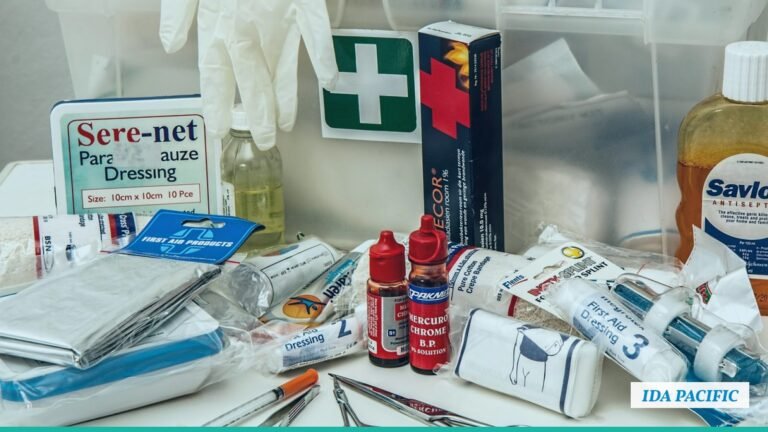
Resuscitation trolley contents, airway adjuncts, emergency dressings and ward first aid kits. These items move slowly but must never be missing or expired. Pre-assembled first aid kits simplify outreach clinics and staff areas.
8. Patient hygiene and general goods
Soap, toothbrushes, wipes, tissues, linen-care products and household cleaning supplies. They are rarely clinical priorities, yet shortages directly affect patient comfort and ward hygiene.
Hospital Use Items by Department
Mapping categories to departments shows where demand comes from and who should own each reorder. The table gives a general picture; adapt it to your facility.
| Department | Highest-use categories | Key storage or handling need | Reorder rhythm |
|---|---|---|---|
| Outpatients | Medicines, dressings, rapid tests | Dispensing area organised by FEFO | Weekly to fortnightly |
| Inpatient wards | IV consumables, gloves, medicines | Ward imprest with set par levels | Weekly top-up |
| Theatre | Sutures, drapes, sterile gloves, gowns | Dry, clean, sterile packs intact | Linked to surgical list |
| Maternity | Delivery packs, maternal medicines, cord clamps | Some medicines need cold chain | Fortnightly plus buffer |
| Laboratory | Reagents, tubes, slides, test kits | Temperature control, short expiry | Small, frequent lots |
| Emergency | Resus items, airway, IV fluids | Checked trolley, sealed and logged | Replace after every use |
Once each department has an owner and a rhythm, the central store can consolidate orders rather than reacting to daily urgent requests.
How to Prioritise Hospital Use Items on a Tight Budget
No Pacific facility can hold everything in unlimited quantity. A simple prioritisation framework helps you protect what matters most when funds are limited.
Use VEN classification
- Vital: items where a stockout risks life, such as IV fluids, emergency medicines and oxygen supplies. Never run out.
- Essential: items needed for routine effective care. Keep reliable buffer stock.
- Non-essential: useful but substitutable. Buy as budget allows.
Combine with ABC analysis
ABC analysis ranks items by annual spend. Usually a small share of items accounts for most of the budget. Review those high-spend lines most carefully for pack size, usage and waste. Pairing ABC with VEN shows you which expensive items are truly vital and which can be rationalised.
Standardise where you can
Choosing one or two standard sizes or types for gloves, cannulas and dressings reduces the number of lines you track, makes training simpler and lets you order larger, better-value quantities.
Step-by-Step: Building Your Stock List
Use this process to build or refresh a hospital stock list. It works for a provincial hospital or a busy health centre.
- Start from your formulary and service list. List the services you actually provide, then the medicines and procedures each needs.
- Pull 6 to 12 months of usage data. Use issue records from the store, not ward requests, which tend to overstate need.
- Calculate average monthly consumption for each line and note seasonal spikes, such as wet-season fevers or cyclone months.
- Set par levels. A common approach is monthly use multiplied by lead time in months, plus safety stock for vital items.
- Classify every line by VEN and by storage need (room temperature, cool, cold chain, controlled).
- Match pack sizes to use. Avoid bulk packs of slow-moving or short-expiry items.
- Agree ordering cycles and consolidate departments into scheduled orders.
- Review quarterly. Remove unused lines, add new ones and adjust par levels.
For the order mechanics themselves, see how to order from IDA Pacific.
Storing Hospital Use Items in Pacific Conditions
Heat and humidity shorten shelf life, weaken packaging and degrade reagents. Good storage protects the money you have already spent.
- Control temperature. Most medicines need storage below 25 or 30 degrees Celsius as labelled. Use air conditioning where possible and log temperatures daily.
- Manage humidity. Keep cartons off the floor on pallets or shelving, away from walls and roof leaks.
- Protect the cold chain. Vaccines, some maternity medicines and certain reagents need 2 to 8 degrees Celsius with monitored fridges and backup power planning.
- Apply FEFO. First expiry, first out. Place shorter-dated stock at the front and label shelves clearly.
- Separate and secure. Keep controlled medicines locked, quarantine damaged or recalled stock, and store flammables away from heat.
WHO guidance on good storage and distribution practice, available via the World Health Organization, is a useful reference when writing your own store procedures.
Choosing a Supplier for Hospital Use Items
In island settings, supplier reliability matters as much as the product. A missed shipment can mean weeks without a vital line. Use these criteria when comparing wholesalers.
Decision criteria
- Quality systems. Ask for evidence of GMP, GDP and ISO 9001 certification across the supply chain. IDA Pacific’s supply chain is certified to all three; see the quality guarantee.
- Regional stockholding. Stock held close by shortens lead times. IDA Pacific holds stock in its own Port Vila warehouse.
- Range breadth. One supplier covering medicines, surgical, diagnostics and equipment means fewer orders, fewer freight bookings and simpler paperwork.
- Pacific experience. IDA Pacific has supplied the Pacific for 16 years and serves 13 countries, so it understands customs, shipping and island logistics.
- Documentation. Expect batch numbers, expiry dates and certificates where required.
Realistic cost factors
The unit price is only part of the cost. When comparing quotes, consider freight and insurance, inter-island transport, import duties and clearance, pack size and wastage from expiry, and the cost of an emergency order if you run short. A slightly higher unit cost from a reliable regional source can be cheaper overall than a low price with long, uncertain lead times. Wholesale prices are shown only to approved trade customers.
Common Mistakes With Hospital Use Items
- Ordering from ward requests alone, which inflates some lines and misses others.
- Buying short-dated stock in bulk to save money, then writing it off.
- Ignoring equipment consumables such as probes, cuffs, filters and batteries.
- No emergency trolley checks, leaving expired items in critical kits.
- Too many brands of the same item, confusing staff and complicating reorders.
- Skipping temperature logs, so stock quality cannot be confirmed.
Most of these are fixed with clear ownership, a written stock list and a routine monthly check.
Conclusion
Planning hospital use items by category, department and priority turns a reactive store into a dependable one. Start with your formulary and real usage, set par levels that reflect island lead times, store stock to survive tropical conditions, and choose a supplier with certified quality systems and regional stock. Explore the full product catalogue to map your list against available lines.
Ready to simplify supply for your facility? Open a trade account with IDA Pacific to see wholesale pricing and start ordering.
Frequently asked questions
What are hospital use items?
Hospital use items are the medicines, consumables, surgical supplies, diagnostics and equipment used in patient care. Buyers usually group them into categories such as essential medicines, medical consumables, surgical supplies, laboratory items, equipment, infection prevention and patient hygiene goods. Grouping by category makes ordering, storage, budgeting and stock audits much simpler for hospital stores.
How do I set par levels for hospital supplies in remote islands?
Start with average monthly consumption from store issue records, then multiply by your lead time in months. Add safety stock for vital items and seasonal spikes such as wet-season illness or cyclone months. Remote facilities need larger buffers than urban hospitals because resupply takes longer. Review par levels every quarter as usage changes.
What is VEN classification and why does it matter?
VEN sorts items into Vital, Essential and Non-essential based on clinical impact if they run out. Vital items must never stock out, essential items need reliable buffers, and non-essential items can be bought as budget allows. It helps hospitals protect patient safety when funding is limited, especially when combined with ABC spend analysis.
How should hospital items be stored in hot, humid climates?
Keep stock in a cool, dry, air-conditioned store where possible, on shelving or pallets off the floor. Log temperatures daily, keep cold-chain items between 2 and 8 degrees Celsius in monitored fridges, and rotate stock using first expiry, first out. Quarantine damaged stock and lock controlled medicines securely.
Can one wholesaler supply all our hospital needs?
A broad-range wholesaler can cover most needs, from essential medicines and surgical supplies to diagnostics, equipment and hygiene goods. Consolidating reduces freight bookings, paperwork and order errors. IDA Pacific supplies 13 countries from its Port Vila warehouse with a supply chain certified for GMP, GDP and ISO 9001. Approved trade customers can view wholesale prices.